|
|

|
|
|
|

|

|
A
new life begins when a mother's egg and a father's sperm meet,
both carry twenty-three microscopic bundles called chromosomes.
As the egg absorbs the bundles from the father join with the
bundles from the mother they merge into forty-six bundles
holding all the information required to make a baby. The
instructions for building a baby are written in the genes, small chemical chains linked
to form the long strands we know as DNA. |
|
|

|
Traits
skip a generation? |
|
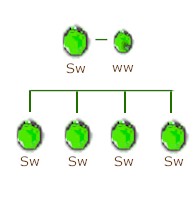 |
The
answers to the gene question was discovered by a monk 125 years ago, is
that some genes are stronger (dominant genes) than others (recessive
genes). The monk, Gregor Mendel,
worked with peas. Some plants, he found, always bore smooth peas,
while others always had wrinkled peas. But marry a smooth-pea
plant with a wrinkled-pea plant, and the offspring are always
smooth because the gene for smooth (S) simply overcomes the
one for wrinkled (w). |
|
|
FIRST GENERATION |

|
|
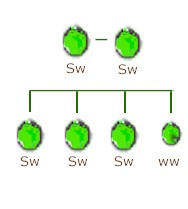 |
So
what happens to the wrinkle gene? Although it doesn't express
itself whenever a smooth gene is present, it is not lost. And if
in the next generation two plants carrying this unseen (recessive)
gene get
together, a quarter (1/4) of their offspring should have only wrinkle
genes, thus allowing this trait to reappear. |
|
|
SECOND GENERATION
|
|
|
| |
|
|
|
 |