|
| |
|


|
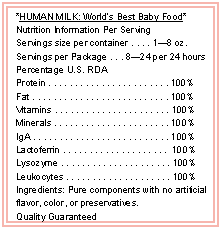
. . . Where
it is not possible for the biological mother to breastfeed,
the first alternative, if available, should be the use of
human milk from other sources. Human milk banks
should be made available in appropriate situations.
WHO/UNICEF Joint Resolution, 1980.
.
. . Human milk is the preferred feeding for all infants,
including premature and sick newborns, with rare exceptions.
AAP Policy Statement on Breastfeeding, 1997.
.
. . Actively incorporate...pasteurized donor human milk into
the health-care framework of medical benefits and preventive
care.
Texas Position Statement on Infant Feeding, 1997
|
|
Denver,
Colorado
(303) 869-1888
Email: mmilkbank@health1.org
San
Jose, California
(408) 998-4550
MothersMilkBank@hhs.co.santa-clara.ca.us
Raleigh,
North Carolina
(919) 350-8599
Email: mmould@wakemed.org or
gbuckley@wakemed.org
Austin,
Texas
(512)494-0800
http://www.mmbaustin.org/
Email: info@mbaustin.org
Mother's
Milk Bank of Iowa
Division of Nutrition
Department of Pediatrics
Children's Hospital of Iowa
University of Iowa Hospitals and Clinics
Iowa City, Iowa 52242
877-891-5347 toll free
319-353-7598 fax
www.uihealthcare.com/milkbank
Vancouver,
BC Canada
(604) 875-2282
Email: fjones@cw.bc.ca
Note: Donors must have Canadian medical coverage.
Banco
de Leche
Veracruz, Mexico
+ 52 55 14 45 51
In the news

|
|
|
|
|
|
|
|
| |
THE
HISTORY OF MILK BANKS
|
|
| |
All
through history women have provided milk for certain infants
whose own mothers were unable to care for them. In the
era before the manufacture of commercial infant formula, it
was well understood that infants fed on substitutes would
likely die. After the industrial revolution, when wet
nurses became difficult to find, human milk banking
arose. Probably the first such milk bank in the United
States was started in 1911 by two Boston physicians who were
concerned about the high death rate in an orphan asylum in
their community.¹ Over the next decades, advances in
the dairy industry helped milk banks develop protocols for
sterilizing, pasteurizing, storing, and freezing mothers’
milk. In 1943, the American Academy of Pediatrics
published its first recommendations for operating human milk
banks. 2 A parallel human milk banking
tradition arose in Europe, which never embraced infant formula
to the extent found in the US. In 1959, there were over
100 milk banks in Germany alone. 3
With aggressive marketing of infant
formula, and especially since the onset of the AIDS epidemic, the
number of human milk banks has declined. At present there are
only a few such institutions operating in the United States.
While the population of infants and children who depend upon donor
milk for health and even survival is small, their numbers are
greater than the currently existing banks can supply.
Additionally, there is increasing evidence that human milk may play
an important role in the treatment of some diseases and conditions
experienced by older children and adults .
|
|
| |
SOURCE |
|
|
| |
1
Riordan J and Auerbach K, Breastfeeding and Human Lactation
1993, Jones and Bartlett. pg 597.
2 AAP: Recommended standards for the operation of
mothers’ milk bureaus, J Pediatrics 1943, 23:112-28.
3 Springer S, Human Milk Banking in Germany, Journal
of Human Lactation 1997, 13(1):65-68.
4 Wiggins P and Arnold L, Clinical Case History: Donor
Milk Use for Severe Gastroespohageal Reflux in an Adult, Journal
of Human Lactation 1998, 14(2):157-59.
http://www.cdc.gov/breastfeeding/compend-milkbanks.htm
|
|
| |
|
|
| |
|
 
|
|
 |